Evritania
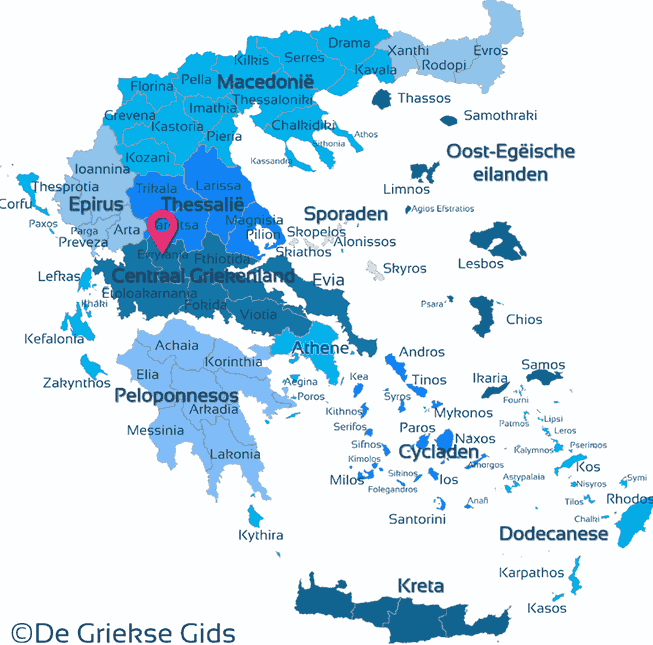
EVRITANIA. Bewitching scenery end an invigorating climate are the main
features of Evritania prefecture. It is the mot thickly wooded,
best-watered region in Greece. There are so many fir trees
in Evritania that you think you 're in the midst of a magnificent
endless forest, and in fact the region has been nicknamed "The
Switzerland of Greece" for this reason. According to Homer,
the first known inhabitants of northern Evritania ware the
Dolopes, who look part in the campaign against Troy. During
the Byzantine era, the people of Evritania had the rare privileges
of self government and tax exemption. For this reason the northern
part of the district was also called "Agrafa", (unwritten),
because the residents ware not listed in the Imperial tax registers.
Its mountainous countryside also discouraged would-be conquerors.
Karpenissi, capital of the prefecture, is located at the
foothills of Mt. Timfristos, at an altitude of 960 metres.
It most probably owes its name to the maple trees that abounded
in the area in the 12th century (Carpen = maple tree, Carpenis
= land of maple trees). The clear atmosphere, the dry healthy
climate, the plane trees, fir and chestnut forests make Karpenissi
an ideal place for winter and summer holidays. Among the
town's most characteristic features are the workshops that
produce hand made brass bells for animals. The tinkling of
the bells being tested is a picturesque, melodious welcome.
When eating at a Karpenissi taverna, try the feta cheese
roasted in wax paper and the local sausages, and before you
leave buy some goat butler and cheese, chestnuts and walnuts.
You will also be impressed by the lovely hand woven fabrics
made on traditional looms and the skilfully carved wooden
objects on safe in the shops. The church of Agia Triada,
the Gorgianades and the site of Kefalovrisso are among the
places in the vicinity we recommend that you visit. Just
5 km. southwest of the capital, coneluding one of the most
beautiful drives, you come to Korishades, a village of well
preserved stone mansions. Here the GNTO has recently renovated
and opened several traditional homes as guesthouses. Not
tar away there are traces of ancient ruins, which have not
yet been studied. Many scholars say that this was the ancient
capital of Evritania, Oiehalia. Next comes Mikro Horio, a
marvellous place for a summer holiday, nestled in a small
fir forest interspersed with apple, cherry and pear orchards.
The view from here is magnificent. Megalo Horio lies nearby,
situated in an equally lovely setting on the slopes of Kaliakouda,
opposite Mt. Helidona. A little trip around the area will
never be forgotten. At Klidi, a lush, majestic gorge, stands
the Byzantine church of Agios Athanassios. After a drive
through trees alongside the Trikeriofi river, you arrive
at the stately monastery of the Virgin Proussiofissa which
possesses a miracle - working icon sold to have been painted
by St. Luke. The monastery church was built in 1754 and is
full of remarkable icons, wood carvings, sacred treasures
and silver utensils. There is also a small museum in the
monastery containing some personal mementoes of Karaiskakis,
the Revolutionary hero. On the 15th and 23rd of August, the
monastery becomes a place of pilgrimage, attracting the devout
from all over Greece. Opposite the monastery stands the chapel
of Agioi Pantes, decorated with old icons. Above it loom
Karaiskakis' watch towers. The village of Proussos, 800 metres
above sea level, is not only picturesque; it has an interesting
cave, the Black cave of "Apokleistra" as it is
also called. Believed to have been the site of an oracle,
the cave has two entrances, one in the village, the other
some distance away. East of Karpenissi, the road from the
verdant village of Agios Nikolaos to Krikelo (1,120 m. alt.),
which has a charming square with little cafes, passes through
some especially beautiful, spruce filled scenery. Near Krikelo
is historic Kokalia. Even though the road is no longer paved
after Krikelo, it is well worth making the effort to get
to Domnitsa, a village crowded with little churches containing
superb wooden icon screens and icons. The region is full
of wildlife - hare, partridge, woodcock, and if you 're in
luck, you may even spot a wild boar. West of Karpenissi lies
Anatoliki (Eastern) Frangista with Ditiki (Western) Frangista
4 km further on, a lush area with a wonderful climate. Here
the little church of the Saviour (Sofir) is worth a visit;
built in 1725, has its walls covered with Byzantine frescoes.
From Oitiki Frangista the road leads north to the village
of Granitsa, whose folk museum is well known. The more intrepid
will want to venture as far as Agrafa, a remote village encircled
by thick spruce forests. It you like fishing, the Agratiofis
river is full of trout. All these mountain villages are "buried" under
snow for many months of the year. Continuing south on the
road from Oitiki Frangista, you reach the lake of Kremaston,
the largest artificial lake in Greece, and from here on to
the prefecture of Etoloakarnania.
Mountain Climbing-Skiing
The Greek Skiing and Mountain Climbing Association maintains
organized refuges on Timtristos (at Diavolofopos, alt.
1,840 m.), and the ski centre at Velouhi (alt. 1,840 m.)
has three ski slopes and a ski school, EOF Traditional
guesthouses at Korishades.
Source:Greek
National Tourist Organisation.