|
Antiquities
of Crete
District of Hania
Aptera.
One of the most important cities of ancient (7th century B.C.)
western Crete. Aptera was built on a site 15 km from Hania, south
of Souda bay, near the village of Megala Horafia which has a view
of the whole plain of Hania. The city walls still standing today
are reminiscent of the Cyclopean walls of Tiryns and Mycenae. One
can also see the remains of a small 1st century-B.C.
temple of Demeter, a Roman theatre and the enormous vaulted
cisterns of the Roman period - according to one source they ware
used for grain storage - preserved in excellent condition.
Phalassarna.
(Falassarna This town, the port of Polyrrhenia, lay to the west
of it, in the base of the extreme northwest peninsula of the
district of Hania. The ruins remains of Cyclopean walls, tombs,
house foundations, sculptures carved out of the rocks, most
notably a throne are found near the village of Koutri. Polyrrhenia
(Polirinia). The ruined walls and acropolis of Polyrrhenia lie 49
km west of Hania, near Selli or Paleokastro. Polyrrhenia, an
important ancient western Cretan city, was founded with the help
of the Archaeans, who succeeded, the Minoans as overlords of the
island. At Kria Vrissi, near Kissamos (Kastelli), are the remains
of a Roman aqueduct.
District of Rethymno
Armeni.
A Minoan cemetery with tombs carved out of rocks has been
unearthed.
Axos.
Finds from a big Greek-Roman city.
Eleftherna.
Recent excavations held at the area brought to light monuments
from a Greek-Roman city.
Zominthos.
A Minoan settlement has been discovered at the Nida plateau, 20 km
from Anogia.
District of Iraklio
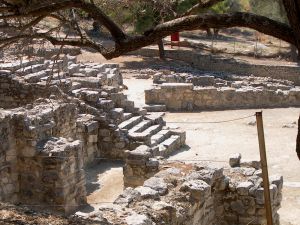
Agias Trias
At Agia Trias 2.5-3 km west of Phaistos, ware found the
ruins of a royal villa, which most probably was the summer palace
of the Phaistos rulers. Certain of the more important pieces on
exhibit in the Iraklio Archaeological Museum -the larnax, the
Harvester vase, and the impeccably painted frescoes- come from the
site. Amnissos.
7,5 km east of Iraklio, the Minoan port of Knossos. It was here
that archaeologists found the Villa of the Frescoes of Amnissos,
also called the Villa of the Lilies. Archanes
(Arhanes) (C7). 1 5km south of Iraklio. Excavations in the village
brought to light a well-preserved building that must have been a
summer palace.
On the hill of Fourni (1km NW of Archanes) there are
vaulted tombs dating to between 2500-1250 B.C.
At Anemospilia, Archanes, in the foothills of the Holy
Mountain of Yiouchta was discovered a Minoan sanctuary sacred not
only to Archanes but to Knossos, as well. Gortyn (Gortis).
46 km south of Iraklio. A city that flourished particularly during
the Roman era. Gortyn was the capital of the Roman province of
Crete and Cyrenaica. It had its origins in the Minoan era, as
testified by the ruins of a 16th-century-B.C. farmhouse, which has
been excavated. The most distinctive monuments are the Praitorium
(2nd c. A.D.) residence of the Roman governor of the province, and
the Nymphaion (200 c. A.D.), where the Nymphs ware worshipped; the
temple of Pythian Apollo the sanctuary of the Egyptian divinities;
and the Odeon, where the famous inscription with the laws of
Gortyn was found. Plato spoke of these laws, which ware written in
a Doric dialect and date from the 6th century B.C., with
admiration. Kato Simi, Vianos.
Sanctuary of Hermes and Aphrodite dating from the Greek-Roman era.
Knossos
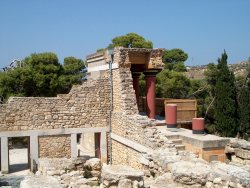
Knossos.
5 km east of Iraklio. Inhabited since the Neolithic era. The first
palace of Knossos was built around 1900 B.C. Two hundred years
later it was destroyed by an earthquake and rebuilt, becoming
grander and more luxurious. The final catastrophe occurred about
1500-1400 B.C., according to one theory, with the eruption of the
volcano on Santorini. Despite this blow, people continued to live
there for another fifty years, until a fire swept through the city
circa 1400 B.C. The Minoan palaces ware not only the residence of
the ruling house, they ware also administrative and religious
centers for the whole region. The ruins of the capitalof the
Minoan Kingdom include the palace of Minos, the homes of the
officials and priests who surrounded him (Uttle Palace,
Caravanserai, House of the Frescoes, etc.), the homes of ordinary
people and the cemetery. The palace was a labyrinthine complex
built around a central court. This multistoried construction
covered an area of 22.000 m2 and, in addition to the royal
quarters, also contained places of worship, treasuries, workshops
and storerooms.
Komos. The Minoan port of Phaistos.
levina (lentas). Excavations brought to light a sanctuary
of Asclepios and Minoan vaulted tombs. lyttos. Archaeological
investigations uncovered finds from a big city of the Greek-Roman
era.
Malia.
34 km east of Iraklio and 3km beyond the summer resort of the same
name. Excavations have brought to light a palace similar to the
ones at Knossos, and Phaistos (also built around 1900 B.C. and
abandoned about 1450 B.C.). At Hrissolakos (Pit of Gold),
archaeologists also unearthed the districts surrounding the
Minoan palace and cemetery. The palace covered an area of about
9.000 m2. Many of the objects now on display in Iraklio's
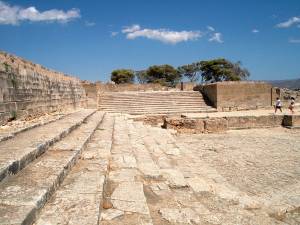
Archaeological Museum ware found at Malia. Phaistos
(Festos). 63 km southwest of Iraklio and about 78 km southeast of
Rethymno, was the second most important palace-city of Minoan
Crete. The residence of the mythical Radamanthes, the palace was
also the nucleus of a settlement inhabited since the Neolithic
age. The architectural layout is identical to that of Knossos.
Here too the rooms are arranged around a court. On the other hand,
in contrast to Knossos, the frescoes decorating the walls ware
relatively scanty, the unpainted floors and walls being covered
with a lining of pure white gypsum. The area of this palace was
9.000 m2.
Tilissos.
14 km southwest of Iraklio lie the ruins of one of the oldest
Minoan cities of central Crete, including three large buildings,
residences of the local lords.
Vathipertro.
19 km south of Iraklio is where the ruins of a large Minoan
mansion, a country estate belonging to a local nobleman, ware
discovered. The ruins include a wine-press, olive press, weaving
rooms and a possible potter's kiln.
Phaistos
District
of Lassithi
Dreros (Driros).
16 km northwest of Agios Nikolaos. The archaeological site of this
ancient Greek city comprises two acropolises with an Archaic agora
between them. South of the agora is a temple from the Geometric
period, the Delphinion, dedicated to Apollo, as well as a large
cistern dug between the late 3rd and early 2nd century B.C.
Gournia.
19 km southeast of Agios Nikolaos, 15 km north of lerapetra, the
best preserved of the Minoan settlements, and one of the most
noteworthy archaeological sites in Crete. It appears to date from
1550-1450 B.C. The ruins of the town include small houses and a
small palace on top of a hill; even the narrow streets and
connecting stairways have survived amidst the foundations of the
houses. ltanos (Ermoupoli). Finds
from a big Greek-Roman city. Kato Zakros. 117 km southeast
of Agios Nikolaos is the site of a luxurious Minoan palace, the
fourth in significance on the island, which produced a number of
important finds, in the Iraklio Archaeological Museum. This
palace, which covered 7.000 to 8.000m2 and contained royal
apartments, storerooms and various work-shops, and the nearby city
ware destroyed around 1450 B.C. by a violent earthquake, most
probably the one that caused a whole section of the island of
Santorini to sink into the sea. Zakros was a
major Minoan naval base, which established trading connections
with Egypt and Anatolia. It was from here that Minoan farming
estates, two sacred peaks, a cemetery and Gave tombs have been
discovered. At Koufonissi. An islet in the south of the
district, are the remains of a Greek-Roman city. Lato. 15
km west of Agios Nikolaos, Lato is spread out on the slopes of two
acropolises. Founded in the 7th century B.C., it was one of the
most powerful cities in Crete in its heyday. The ruins include the
city walls, houses and shops from different periods built on
terraces. Makrigialos. Finds from villas from the Minoan
and Greek-Roman eras. Mirtos. Remains of Minoan settlements.
Palekastro. 90 km east of Agios Nikolaos, 20 km from Sitia, at
Roussolakos, has soma remains of a port settlement. Petras
Ruins of a Minoan city. Psira Islet in the
north of the district with ruins of a Minoan settlement.
Source: GNTO
|