|
Venetian
buildings of Crete
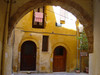
Hania
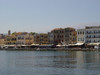
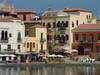
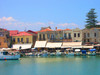
On the Venetian city of Hania one whole neighbourhood remains,
while of the fortifications (early 13th century), the bastions,
moat and ruins of the walls surrounding the city have survived.
Other monuments from that era are the Loggia (once a gentlemen's
social club), the Hiones (Neoreia) (16th century), the breakwater
of the Venetian harbor and the churches of San Francesco (the
Archaeological Museum), San Rocco, and of the Savior (tou Sotiros).

District of Hania
Southwest of Kissamos, 43 km west of the city, near the village
of Kalathenes, is the Villa Rotonda, most probably the country
estate of soma Venetian feudal lord, dating to the period between
1500-1600. At Agria Gramvoussa , a remote islet in the northwest
part of the district, are the remains of a Venetian fort. Getting
to the islet is difficult, and can only be done by caique from
Kissamos, weather permitting, departing early in the morning
during the summer. At Paleohora, washed by the waves of the Ubyan Sea, 73 km south
of Hania, the ruins of Castel Selino rise out of the shore.
This fortress was built in 1279 by Duke Marino Gradenigo, governor
of Crete. Frangokastello about 11 km east of the Hora Stakion
(Sfakia), is the site of the old "Castel Franco" (Frankish
Castle), built by the Venetians in 1371 as a defence against
pirates and Cretan rebels.
Rethymno
The Great Gate, one of the old city gates left over from the
Venetian fortifications of 1540-1570. The Loggia,
mid-16th century, was a social club where the lords and noblemen
used to meet and relax. It is now the Archaeological
Museum. The Rimondi Fountain, north of Petihaki Square, a 17th century work. The Fortezza, north of the city, on Paleokastro
hill. Built in 1574, it offers a marvellous view of the city
and the sea. The facades of Venetian houses, most of which are
found in the old city. The churches of San Francesco and Our
Lady of the Angels, known as the church of the "little Virgin" (Mikri
Panayia).
Iraklio
The old fortifications at Handak, reinforced for the Venetians
in 1462, are still in good condition today. Of the fortress's
seven bastions, the one called Martinengo - where the simple
tomb of Kantzakis is located - has survived and offers a view
over the entire city. Two of the four entrance gates to the
city, the Hania Gate and New Gate, still stand on the south
side. Koules is the name of the imposing fortress at the entrance
to the Venetian harbour. It was constructed between 1523 and
1540.
The Bentenaki, the breakwater running from the Venetian harbour
to the bay of Oermata of Koum-Kappi. The vaulted arsenals, the
shipyards where the Venetian galleons ware built. The Morosini
(1628), Delimarco (1666) and Bembo (1588) fountains on the north
side of Kornaros Square. The Palazzo Ducale, the residence of
the Duke of Crete and the Loggia (reconstructed), the noble's
social club. The Basilica of San Marco (13111 c.) today an exhibition
hall, and the Orthodox church of Aghios Titos (1446).
District of Lassithi
Spinalonga. Rock-isle at the entrance to Elounda Bay, 12 km from
Agios Nikolaos, the site of the ruins of a fortified castle
built by the Venetians in 1526 to prevent enemy ships from
entering the harbor. Sitia 70 km east of Iraklio. The scant
remains of a fortress built during the Byzantine era stand
on the western limits of the city. lerapetra. 36 km southeast
of Agios Nikolaos. On the far western side of the town, near
the sea, lie the ruins of a fortress erected in the early years
of the Venetian rule and radically rebuilt in 1626 by Francesco
Morosini the elder when he was Governor of Crete.
Source:
GNTO
|