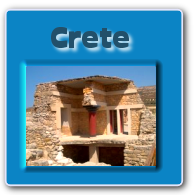

Crete

Crete Travel Tips

Natural Landmarks  

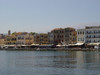
Hania, Rethymno, Iraklio, Agios Nikolaos, Sitia, lerapetra - each one of these cities has a distinct personality that attracts many visitors to the island.

The Samaria Gorge. 43 km from the city of Hania, this is the longest gorge in Europe, measuring same 18 kilometres and renowned for its awesome beauty. At same points the passage is just 3 meters wide and at times the sleep sides rise to a height of 600 meters. The gorge is cut by a stream which flows between the highest peak of the White Mountains and Mt Volikas. Hiking down the gorge is permitted from May until late September, and weather permitting until late October. At the entrance to the gorge, at Xiloskalo, there is a tourist pavilion with a view of majestic Mt Gygilo (alt. 2.083m). On leaving the gorge one encounters the village of Agia Roumeli where one can take a launch to Hora Sfakion and catch a bus back to Hania. The road from Hania to the entrance of the gorge traverses picturesque lowland and mountain villages. At the village of Omalos and the Omalos mountain range one will find rooms for rent and a number of taverns.

The Lassithi Plateau. 22 km east of Iraklio the road passes through the wooded villages of the plateau (alt. 900m, area about 25.000m2) punctuated by same 7000 colourful windmills that water the market gardens and apple and pear orchards in this lush region.

Hora Sfakion. 74 km south of Hania, an unusual village built in a rocky, barren area, difficult to reach whether by sea or overland. To get there one crosses the Askyphos mountains and the Nimbros gorge.

Gavdos. An islet 24 nautical miles south of Sfakia (Hora Sfakion). There are scheduled boats from Sfakia to this virgin isle with its spotless beaches and its cedar trees all year long (weather permitting). The island boasts same taverns and a few rooms to let.

The Therisso Gorge. An impressive gorge, 6 km long running between Hania and the village of Therisso at the foothills of the White Mountains, 16 km south of Hania.

Lake Kournas. 48 km east of Hania. A picturesque lake, the only one on the island. The mountains surrounding it are reflected in its calm waters. There are taverns in the area for a bite to eat.
Gavalohori.
Traditional settlement situated about 26 k. SE of Hania, surrounded by olive and oak trees. Its name comes from Philip Gavalas, a Byzantine who settled there between 1080 and 1182 obeying the Byzantine emperor. A Historical and Folklore Museum operates there. It is housed in a building which is characteristic of the local traditional architecture that used to be developed in two levels. A part of the building was constructed during the Venetian period, where as the second floor was added during the Turkish period. Among the exhibits one can see furniture, hand-woven and silk fabrics, embroideries, stone and wood carvings, samples of iconography and pottery, weapons, coins, etc. In the village square there is an office of the Women's Agricultural Cooperative of Gavalohori where one can either get information about the area or buy products made by the locals.

Argiroupoli. 27 km southwest of Rethymno. A village nestled among greenery, built on a knoll not far away from springs feeding same enormous cisterns and setting watermills in motion.

Spili. 28 km southeast of Rethymno. A wooded village with stone houses and cobbled lanes. In its small square overhung by plane-trees there are 25 water spouts, sculpted in the shape of lions heads, whose water comes directly from Psiloritis.

Anogia. A mountain village, 53 km southeast of Rethymno, famous for its woven cloth.

Fodele. 29 km west of Iraklio, the birthplace of the famous painter EI Greco (Domenicos Theotokopoulos) in 1545. A picturesque village hidden in a verdant valley studded with orange groves and plane trees.

Hrissi. An islet lying exactly opposite lerapetra, 9 n. mi. away, reachable by small excursion boats. It too boasts lovely beaches and cedar trees.

Matala. Matala became famous because of its unique location in between the chalk-cliffs, by which the many holes give the place its characteristic face.

Preveli. Preveli is famous for its palm beach and because of the monastery which was erected at the end of the 16th century.

Vai. For Greece a unique palm tree wood with a beautiful blue sea gives Vai the appearance of a paradise.

Caves

The Greek Speleological Society has recorded over 3.000 caves in Crete. Not only astounding examples of nature's talent for interior decoration, many of them are also of great scientific value, being of archaeological, paleontological and historical interest. Man used caves as places of worship and as dwellings from the Palaeolithic era onwards. The Minoans began the custom of worshipping their gods in small palatial or house shrines, in sacred caves and in shrines built on mountain peaks and the tops of hills.

The Cave of
Sentoni Zoniana. This is Crete's richest Cave in terms of natural decoration. It lies in the District of Rethymno, 13 km west of Anogia and 1 km from the village of loniana at an altitude of 800 m. The Diktaian Cave (Dikteon Andron) The legendary birthplace of Zeus, this cave can be reached by going to the outskirts of the village of Psihro (48 km east of Iraklio and 52 km west of Agios Nikolaos), where there is a path ascending to it. Significant archaeological finds indicate that the Cavewas long a place of cult worship. One can go from the village to the cave on foot or by mule or donkey, which can be rented from the locals. The descent info the fascinating cave demands some caution. Stalactites of various shapes adorn the lower cave. The Ikaian Cave (Idoen Andron). 20 km south of Anogia on the upland plain of Nidas, on Mount Psiloritis, lies this sacred Cave where according to mythology Rhea hid the baby Zeus from the murderous Kronos. Cult objects have been found here, along with statues and bronze shields and other finds now on display in the Iraklio Archaeological Museum.  The Caveof Eileithyia (Ilithiia). This cave was used for cult rituals from the Neolithic era up to the 5th century B.C. Lying 1 km south of Amnissos, it was sacred to Eileithyia, the goddess of childbirth. Archaeological investigations here uncovered idols of woman in the act of giving birth, nursing or praying, figures of animals, Neolithic shells and tools. The cave of Ag. Paraskevi Skotinou. 22 km from Iraklio. This very interesting cave was used for cult worship both in antiquity and during the Christian era. The Kamares Cave. Northeast of the village of Kamares (57 km from Iraklio) lies the cave of Kamares, established during the Minoan period as a sacred spot, possibly dedicated to the worship of the goddess Eileithyia. The wonderful Kamares vases, on display in the Archaeological Museum of Iraklio were found here. Visiting the cave entails a 4-hour walk from the village.  The Gerani Cave of Rethymno. 6 km from Rethymno, this is a cave of prehistoric and archaeological interest. Finds from this Cave may be seen in the Rethymno Archaeological Museum. The Melidoni Cave. 3 km from the village of Melidoni (26 km east of Rethymno), this was used for cult worship during the Neolithic, Minoan and Archaic periods.

Churches and monasteries of Crete

In 65 AD., Titus, disciple of St Paul, founded in Gortyn the first Christian community. In the 16th century the Cretan School of Painting, closely allied with Byzantine tradition, produced numerous painters of icons, both famous and unknown. Crete is scattered with the ruins of countless frescoed churches dating from 961, when the Byzantines recaptured Crete from the Saracens, to 1204, when the island fell into the hands of the Venetians.


1~1.jpg  Agios_Titos_Heraklion.jpg  kerkje.jpg  2 Kreta 2003 (119).jpg  IMG_0051c.JPG  8.jpg

In Hania
The chapel of the Moneyless Saints (Agii Anargyri) with old Byzantine frescoes. The Russo-Byzantine church of Agia Magdalini in the Halepa quarter.

In the District of Hania
At Akrotiri, northeast of the city (16.5 km), the Monastery of Agia Triada (Tzangarol), with a fine gate and church, built in 1632. Near Agia Triada, the Monastery of Our Lady of the Angels or Gouvernetou, founded in 1548, has a Renaissance style church whose impressive façade is decorated with Venetian sculptures. The Gonia Monastery, (24 km west of Hania), near the village of Kolimbari. Also called the Hodigitria (Madonna as Guide), it has a lovely view and buildings dating from 1662. At Kato Episkopi, a village about 10 km south of Kolimbari, the Rotonda of the Archangel Michael with interesting mosaic floors and important frescoes by Byzantine artists of the 12th century. At the village of Alikianos, (13 km southwest of Hania), the Byzantine church of St George with frescoes dated from 1430. At the village of Sougia, on the south coast of the district, there are soma exquisite mosaics from an early Christian 6111-century basilica preserved in the village's modern church.

In the District of Rethymno
The Monastery of Arkadi (Moni Arkadi,), (23 km southeast of Rethymno) , built in 16th century in a wonderful natural setting. There is a tourist pavilion outside the monastery.
The Monastery of Preveli (36 km south of Rethymno). A historic monastery well worth visiting with a small museum and beautiful view of the Libyan Sea (Liviko Pelagos).

In Iraklio
The cathedral of Agios Minas and the smaller church of Agios Minas beside it. The church of St Catherine (Agia Ekaterini), containing icons by Michail Oamaskinos, the most important representative of the Cretan School.

In the District of Iraklio
At Skotini, about 1 km northwest of Fodele, the little church of the Presentation of the Virgin (Issodia tis Theotokou) built on the site of an cider church of the 11th or 12th century.
About 56 km southwest of Iraklio the Monastery of Vrondissi with a fountain carved in relief (15th c.) at the entrance to the garden and a panoramic view. Further southwest, near the village of Vorizia (52 km from Iraklio), the abandoned monastery of Varsamoneri. Here one can see the church of Agios Phanourios whose 15th-century frescoes are of great artistic and scientific value, a unique monument of the Cretan School. At Gortyn (Gortis) he three-apsed basilica (6th century) dedicated to St Titus, one of the most important monuments of Christianity in Crete. Near Krassi, west of Agios Nikolaos, the Monastery of Kardiotissa, with its church consecrated to the Virgin of Kera.

In the District Lassithi
Some 9 km from Agios Nikolaos before the village of Kritsa, the church of Our Lady of Kera, filled with frescoes from the 14th or 15th century and judged to be the finest in Crete. East of Sitia (18 km), the Monastery of Toplou or the Panayia (Virgin) Akrotiriani, dating from the 15th century. The monastery contains an inscription from the 2nd century B.C. and a famous 18th century iron by loannis Kornaros. South of Sitia (41 km), the Monastery of Kapsa .

Venetian buildings of Crete

Hania
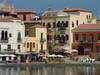
On the Venetian city of Hania one whole neighbourhood remains, while of the fortifications (early 13th century), the bastions, moat and ruins of the walls surrounding the city have survived. Other monuments from that era are the Loggia (once a gentlemen's social club), the Hiones (Neoreia) (16th century), the breakwater of the Venetian harbor and the churches of San Francesco (the Archaeological Museum), San Rocco, and of the Savior (tou Sotiros).

Dsc01287.jpg  DSC01018.jpg  image51.jpg  13.jpg 212-1278_IMG.JPG  


District of Hania
Southwest of Kissamos, 43 km west of the city, near the village of Kalathenes, is the Villa Rotonda, most probably the country estate of soma Venetian feudal lord, dating to the period between 1500-1600. At Agria Gramvoussa , a remote islet in the northwest part of the district, are the remains of a Venetian fort. Getting to the islet is difficult, and can only be done by caique from Kissamos, weather permitting, departing early in the morning during the summer. At Paleohora, washed by the waves of the Ubyan Sea, 73 km south of Hania, the ruins of Castel Selino rise out of the shore. This fortress was built in 1279 by Duke Marino Gradenigo, governor of Crete. Frangokastello about 11 km east of the Hora Stakion (Sfakia), is the site of the old "Castel Franco" (Frankish Castle), built by the Venetians in 1371 as a defence against pirates and Cretan rebels.

Rethymno
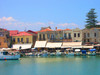
The Great Gate, one of the old city gates left over from the Venetian fortifications of 1540-1570. The Loggia, mid-16th century, was a social club where the lords and noblemen used to meet and relax. It is now the Archaeological Museum. The Rimondi Fountain, north of Petihaki Square, a 17th century work. The Fortezza, north of the city, on Paleokastro hill. Built in 1574, it offers a marvellous view of the city and the sea. The facades of Venetian houses, most of which are found in the old city. The churches of San Francesco and Our Lady of the Angels, known as the church of the "little Virgin" (Mikri Panayia).

Iraklio
The old fortifications at Handak, reinforced for the Venetians in 1462, are still in good condition today. Of the fortress's seven bastions, the one called Martinengo - where the simple tomb of Kantzakis is located - has survived and offers a view over the entire city. Two of the four entrance gates to the city, the Hania Gate and New Gate, still stand on the south side. Koules is the name of the imposing fortress at the entrance to the Venetian harbour. It was constructed between 1523 and 1540.

The Bentenaki, the breakwater running from the Venetian harbour to the bay of Oermata of Koum-Kappi. The vaulted arsenals, the shipyards where the Venetian galleons ware built. The Morosini (1628), Delimarco (1666) and Bembo (1588) fountains on the north side of Kornaros Square. The Palazzo Ducale, the residence of the Duke of Crete and the Loggia (reconstructed), the noble's social club. The Basilica of San Marco (13111 c.) today an exhibition hall, and the Orthodox church of Aghios Titos (1446).

District of Lassithi
Spinalonga. Rock-isle at the entrance to Elounda Bay, 12 km from Agios Nikolaos, the site of the ruins of a fortified castle built by the Venetians in 1526 to prevent enemy ships from entering the harbor. Sitia 70 km east of Iraklio. The scant remains of a fortress built during the Byzantine era stand on the western limits of the city. lerapetra. 36 km southeast of Agios Nikolaos. On the far western side of the town, near the sea, lie the ruins of a fortress erected in the early years of the Venetian rule and radically rebuilt in 1626 by Francesco Morosini the elder when he was Governor of Crete.


Top destinations

Athens vacations
Crete vacations
Thessaly vacations
Epirus vacations
Cyclades vacations