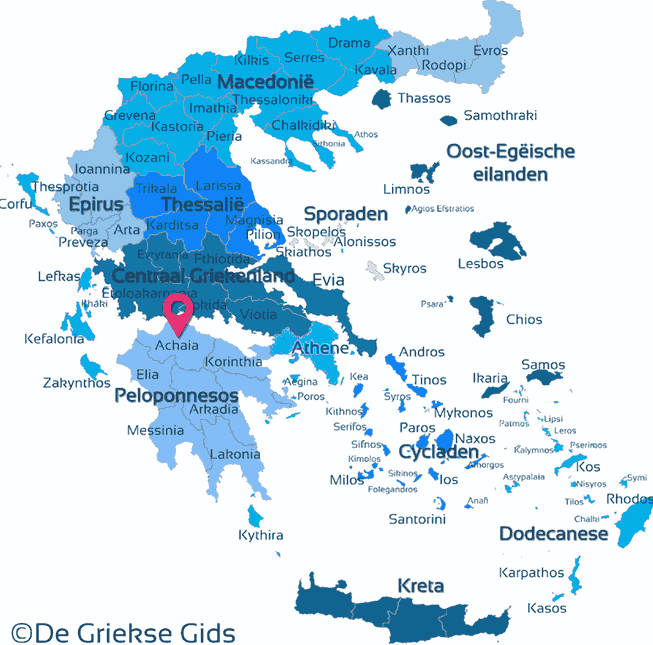
Achaia
After the decline of the Mycenaean centres, Achaians from the
Argolid came and settled here, founding important cities. The
region is named Achaia after them. Though politically insignificant
through most of antiquity, it started to play a more dynamic
role in 280 BC, when the Achaian Confederacy was created. In
146 BC the area fell to the Romans. It embraced Christianity
earlier than the rest of Greece (St. Andrew the Apostle preached
in Patras and was martyred there). In 1205 it occupied centre
stage with the founding of the Principality of Achaia by the
Franks. Before too long it passed to the hands of the Palaiologues
who ruled the Peloponnese from Mistra; they were succeeded
by the Turks in 1460. For a short period (1687 - 1715), the
area was a Venetian colony. It was liberated in 1828.
A trip to Patra
Patra is the capital of the prefecture. It owes its name
to Patreas, chief of the Achaians. The city is among the
most important in Greece, and the largest in the Peloponnese.
It is also a major transportation centre, linking the country
with Italy and the Peloponnese with the lonian islands. The city extends from the shore up to the Castle. It is divided
into two parts, the upper and the lower; there is a clear
distinction amongst two parties made by the different layout,
parks and plazas. The old city, at the foot of the caste,
still has quite a number of attractive neoclassical houses,
while in the lower city still remain same old mansions, such
as those housing the Municipal Theatre, the Odeon, etc. The
Cathedral of St. Andrew, the city's patron, rises majestically
above the lower city. To its left stands an older church
built on the site of a Byzantine church that was destroyed
by the Turks. From that point "Trion Navarchon" street
leads to Psila Alonia -the "balcony" of Patras
- a lovely spacious square with slender palm trees and a
sun dial. Patras possesses a fine archaeological museum,
an art gallery and a printing museum. Dominating the city
from on high looms the ruined shell of the castle, whose
grounds have been transformed into
a park. From here one can see the view of the whole city
and the sea beyond. Patras' famous Carnival -proof for the
citizens' imagination, humour and high spirits attracts thousands
of visitors every year. Finally, the city's
innumerable pastry shops, the quiet coffee shops, the wide
range of taverns, the lively streets bustling
with locals, foreigners and transient travellers complete
the picture of the beautiful city of Patras.
Along the coasts
The coasts of Achaia are a delightful concoction of picturesque
villages, indented shores, gardens and shady trees. A treat
for the eye. While the heart of Achaia beats up to its
mountains, one cannot fail to feel its soul in the murmur
of the sea. Leaving Corinth, the coast road leads all the
way to Patras. The itinerary is more scenic than the National
Road, since it is right on the water's edge. On their way
visitors reach Akrata, a coastal village, set in lush surroundings
on a crystal clear sea. This was the site of ancient Aigai.
In vicinity, a sight worth seeing is the post-Byzantine
monastery of Agia Triada (1715), which has well-preserved
mosaics. Next come Platanos, Trapeza, verdant hamlets,
and Diakofto. This is where the funicular railway leaves
for Kalavrita. Continuing along the coast road, one village
after another are revealed through the green of the hillsides.
Short stop in Egion. The town, is divided into an upper
and a lower section; the old district near the shore is
more interesting; an enormous plane tree the one mentioned
by Pausanias on his travels still reigns supreme. The church
of the Virgin Faneromeni, built according to designs by
Schiller, lies in the upper town. Just outside the town
one can visit the chapel of the Virgin Trypiti, tucked
into a crevice in a rock. The parade of villages continues.
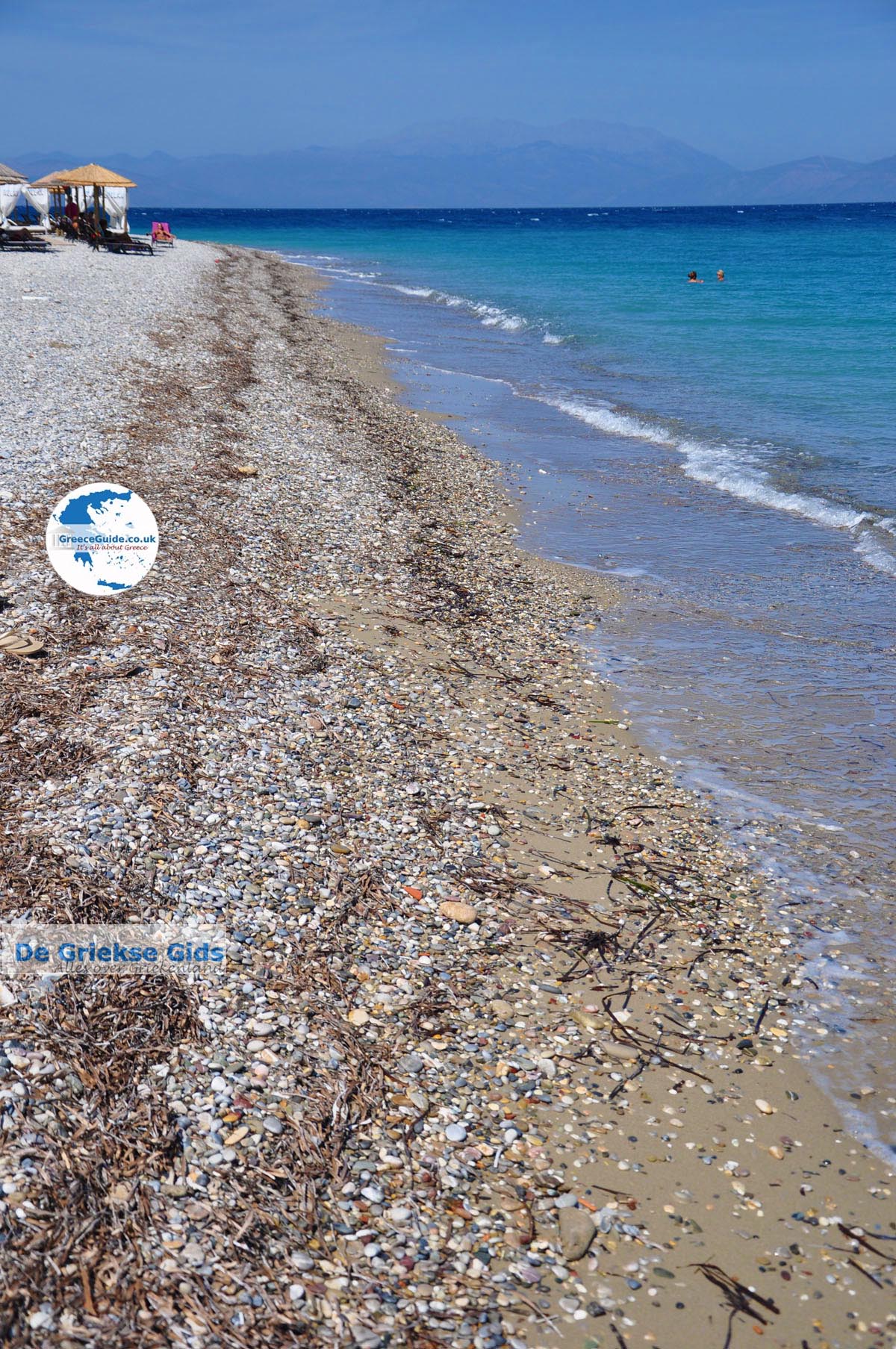
Longos, with its pebbly beach, Lambiri, with its lovely
shore, Psathopirgos, a pretty hamlet. Each one has its
own characteristics, its distinguishing features. All of
them have a little taverna or a quaint café where visitors
can relax for a while. Right before Patras there is Rio,
a transportation hub, uniting the Peloponnese with Central
Greece and Epiros by ferry boat (to Antirio). Jutting towards
the sea, the old Venetian fortress, the "Castle of
the Morea", faded and ravaged by time, is the first
thing to strike the eye. Passing through Patra the old
Patras-Pirgos road is in good condition; it has a view
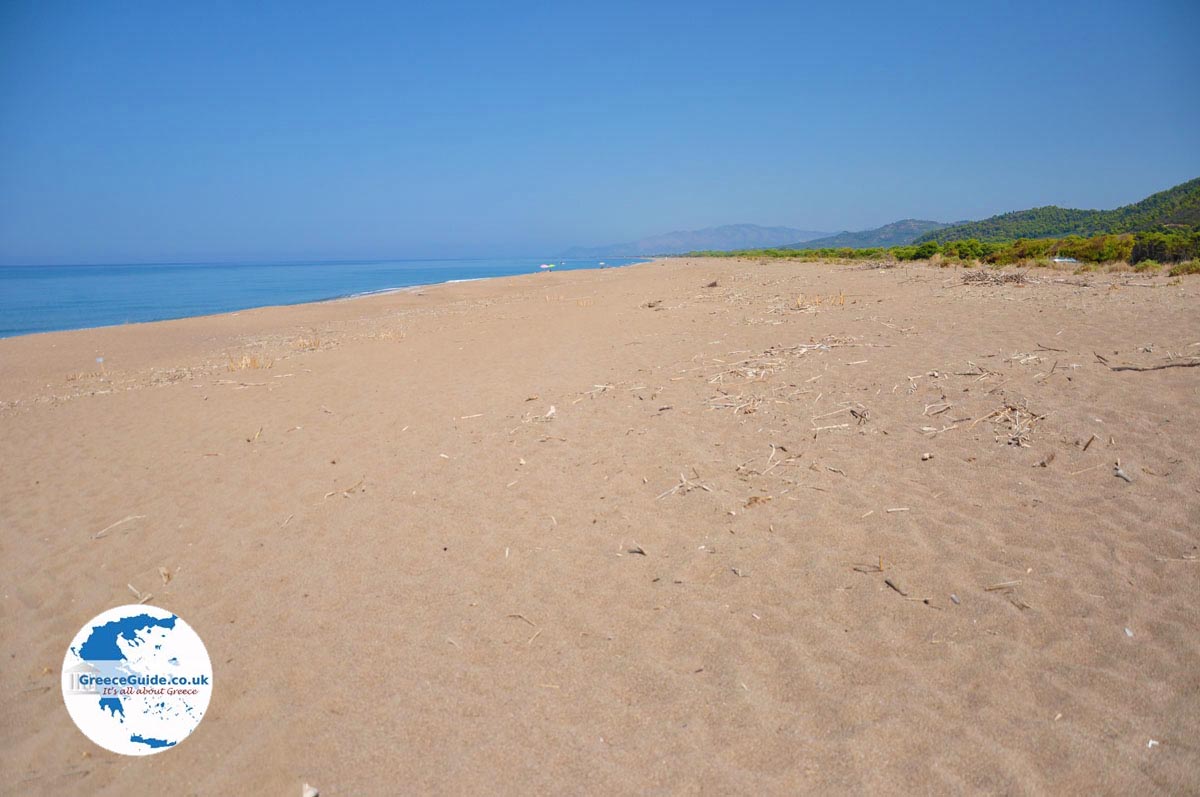
on the sea, endless stretches of sandy beach (Araxos) and
charming villages lapped in greenery. This little jaunt
ends at Kalogria in time for an afternoon dip and a rest
on the white sand.
The mountains of Achaia
The mountain villages of Achaia are scattered all over the
three higher peaks, Mts. Panahaiko, Erimanthos or Olanos,
and Aroaneia or Helmos.
Set atop invisible plateaus or on precipitous slopes amidst
a riot of vegetation, these singularly lovely and picturesque
villages inspire wonder in the wayfarer.

Diakofte-Kalavrita |
|

Diakofte-Kalavrita
|
|

Station Zachlorou |
|

Zachlorou |
|
Kalavrita First Itinerary
One can gat to Kalavrita by car from Patras, the coastal
village of Trapeza or by funicular from Diakofto. The Patras-Kalavrita
road passes through vineyards, olive grooves and small, well-wooded
hills. At a certain point the landscape changes; it becomes
more mountainous as the ascent to the magic mountains begins.
Aromas, scents and cool air win the visitor over immediately.
Plane trees and walnuts stand out to the right and left side
of the road. Halandritsa: stone houses, court yards, narrow
lanes, a ruined Frankish castle, countless churches, bell
towers with a Western touch. The heart of Achaia begins to
pound. Next come the villages of Katarrahtis, Kalanistra,
Kalanos. Mihas, perched on a hillside thick with walnut trees,
catches the eye. After passing Kato and Ano Vlassia, both traditional hamlets
built in 1660, it is worth it to stop for a while at Flamboura.
A dirt road leads to the Monastery of Makellaria. An inscription
relates that the monastery was built by Velissarius, Justinian's
general, in 532. It contains a Byzantine icon of the Virgin,
endowed with a curious feature: it gives the impression to
the visitor that the Virgin's eyes follow him wherever he
stands. Back to the main road, anyone of the many side roads
lead to a forest, gorge or Byzantine monastery. Kalavrita
lies ahead. These places and their myriad tiny villages are
difficult to describe. To get to know them, it is essential
to get out of the car, walk through the streets, visit the
castles and churches, mingle with the people, take a drink
with them and clink the glasses in a toast. Only then the
heart of Achaia beat can be felt.
Kalavrita Second Itinerary
The trip on the funicular railway resembles a journey in
a dream. Once the train has left the tranquil, peaceful landscape
of Diakofto, it delves into the deep gorge of Vouraikos river
that runs down from Helmos. Before long the little train
is clutching the rails with its "teeth". The higher
it goes the more nature's silent work is appreciated. Enormous
rocks, boulders gnawed by time, trees hanging from the mountain
slopes call forth awe and admiration. The first stop - pause
for breath - is at Trekilia for a quick cup of coffee; then
on to the village of Zahlorou at an altitude of 642 m. This traditional village possesses a rare natural beauty.
The town of Kalavrita, the third stop on the funicular, is
spread out on the slopes of Helmos at an altitude of 750
meters. Numerous tall plane trees offer their shade. They
line the streets like an arcade. The charming houses, streets,
trees all make you feel at home. The town exudes tranquillity.
Just outside town a Venetian fortress, "the castie of
Orea", stands atop a bluff.
Mega Spileo
The monastery can be reached by road from the village of
Trapeza or by footpath from Zahlorou. There is a feeling that the hand of God is leading to the
monastery. The grandeur of nature, astonishes the visitors.
The view is a perfect gift-offering from the monastery. It
is located at 1000 meters above sea level. Behind, an enormous
building resembling to a fortress, the legendary monastery
rises with total eight stores within a gaping cavern. Built
in 362, it has since remained firmly wedged in Greek history.
The 17th century monastery church has wonderful - but damaged
frescoes, mosaic floors and a bronze door with engraved decoration.
The icon of Virgin Mary holding the Christ Child in her right
arm is a relief made of wax and mastic, attributed to St.
Luke. The monastery museum contains holy relics and treasures,
an icon screen of great age, carved wooden crosses, venerable
manuscripts, Gospels, and the like. The silhouettes of the
monks with their long hair, full beards and erect figures
testify that another way of life - the ascetic way, so different
from our own - reigns in this place.
Agia Lavra
The monastery of Agia Lavra at 6 km. from Kalavrita, is built
at a point which commands a view of the whole Vouraiko
river valley. Constructed in 961 at an altitude of 961
meters, it once also had 961 monks. It was at this building
- which dates from 1689- that the call for "freedom
or death" first rang out in 1821, commanding Greeks
to defend their heritage and throw off the Turkish oppressors.
The revolutionary banner was raised in the garden under
the historic plane tree. The monastery church has a fine
carved icon screen, frescoes damaged by fire and the icon
of Agia Lavra. Apart from the revolutionary banner, the
relics include a very old Gospel, a gift of Catherine the
Great; gold crosses; reliquaries and a valuable collection
of early Christian and ancient objects. On a hill opposite, a monument to the heroes of the Revolution
of 1821 looks down over the monastery.
Ski Centra
The Helmos Ski Centra lies at 14 km. from Kalavrita on the
main peak of Helmos. It has two lifts to an equal number
of lodges and slopes. Lift A goes up to 1800 meters, while
Lift B serves the higher peak (2,440 m.). From the higher
lodge one can see the Gulf of Corinth, gleaming like a
huge lake; from the ridge of the mountain, Neroldorachi,
almost the whole Peloponnese lies at your feet. It
is from Neroldorachi that one makes the descent to the
waters of the river Styx. According to myth, the Styx marked
the entrance to Hades. its parents were Night and Erebus.
Today the locals call it "Mavroneri" (Black Water),
because of its colour in the depths of the ravine where it
flows. The ancient Greeks believed it to be the fountain of immortality
of the gods.
The cave of the lakes. - Kastria
A half-hour's drive from Kalavrita, near the village of Kastria,
leads to the Gave of the lakes. A narrow passage takes you into a first small Gave that broadens
into an enormous cavern 2 kilometres long with 15 miniature
lakes formed by natural dams. The stalagmites and stalactites
with their extraordinary shapes, the iridescent colours,
the immense boulders, the small waterfalls and the tiny lakes
with their natural dams stimulate and delight the imagination.
And now let's take a trip to the cool green villages where
one can see antiquities (Klitoria, Likouria) or vestiges
of Frankish and Byzantine rule. Each village has a precious
gift to offer, something truly beautiful. There are so many springs on the way. Here and there wayside
shrines. Sometimes a flock of sheep blocks the passage on
the road and you' ll hear the cautionary growl of the sheepdog,
but the friendly nod of the shepherd will accompany you to
the nearest hamlet. Near by the village Pagrati, there is
the famous "vine branch" of Pausanias, with very
big branches, dating back to thousands of years. Some villages
climb up a ravine (Aroania, 930 m.), others are smothered
in fir trees (Kertezi, 1050 m.). The houses are all made
of stone, with roots of tile. There are also same traditional
houses with towers. All the villages have their main square,
a fountain with gushing water, a small café or a taverna.
Kertezi is renowned for its bean soup and glorious wine.
And each place has a story to tell, whether about its Byzantine
church and miraculous icon, its local caste or distant myth.
People will greet you like a dear old friend. And it won't
take long before you really are friends. It will be hard
to drag yourself away. Village people are a warm presence
in Achaia. Their tables are laden with bread, olives, cheese,
wine and kindness.
Source: Greek National Tourism Organisation